Every once in a while, people who refuse to accept "the way things are" appear.
In 2008, while the world was busy bailing out a broken financial system and calling it "too big to fail," one (or more) anonymous mind(s) quietly decided it wasn't.
Instead of writing a thread, signing a petition, or begging for reform, he wrote code.
Code that challenged a century of central banking, currency control, and permissioned access to money.
That person - Satoshi Nakamoto - didn't just spot what was wrong, but built an alternative. With code.
This is what extreme high agency looks like. Let's unpack it.
What Is "High Agency"?
George Mack describes high-agency people as those who don't accept "that's just how it is."
- Don't accept "that's just how it is."
- Don't wait for permission.
- When they hit a wall, they look for a window. And if there's none, they build a door.
Low-agency mindset: "The system is broken, there's nothing I can do."
High-agency mindset: "The system is broken, I'll design a better one."
Satoshi is the latter mindset in its purest form.
The Problem He Looked At
He didn't try to launch "another payments app."
He looked at the core problem of modern money and digital payments:
- Digital payments that always require trust in someone in the middle
- Centralized issuance
- Centralized control
- Central banks and intermediaries deciding who can use money, when, how, and under what rules
And the killer technical issue behind all of this: how do you create digital money that can't be copied, faked, or double-spent without a central authority keeping score?
For decades, that was considered an unsolved computer science problem - known as the Byzantine Generals Problem:
Imagine several generals surrounding a city. They all need to attack at the same time to win. But they're far apart. They can only communicate by messenger.
- What if one messenger lies?
- What if another gets intercepted?
- What if one general sends the wrong signal - intentionally or not?
How can they all agree on one truth, when they can't fully trust the messages or the messengers?
In digital systems, this means: how can thousands of computers around the world agree on the same version of reality - without trusting each other, and without any central coordinator keeping score?
Everyone knew the question. Nobody had a working answer. Most people stopped there.
A certain high-agency problem solver didn't.
What Most People Get Wrong: "Blockchain" Wasn't the Genius
Blockchain became a buzzword. Chaining blocks of data together with hashes? That existed before Bitcoin.
Haber and Stornetta in the 90s were already using cryptographic chains to timestamp documents and make logs tamper-evident. Useful, but it didn't create digital money. A chain of blocks is not the breakthrough. It's just a data structure.
Satoshi's genius was something else.
The Real Innovation: Nakamoto Consensus
Satoshi combined several components into one system that had never existed before:
- Proof-of-Work
- A peer-to-peer network
- A public ledger (timechain)
- Economic incentives
- Clear rules every node can verify
In simple terms:
- Anyone can join the network. No permission.
- Miners spend real-world energy (Proof-of-Work) to propose blocks.
- Nodes verify every rule: no fake coins, no double-spends, no cheating.
- The chain with the most accumulated work (the most energy spent honestly following the rules) becomes the truth.
- If you try to cheat, the network rejects you. You waste your energy. You lose.
- No central authority.
- No "trusted" database admin.
- No one person to bribe, hack, or pressure.
That coordination mechanism is Nakamoto Consensus. That's the genius.
Bitcoin is not "just blockchain." Bitcoin is a new trust model. A way for thousands of strangers to agree on who owns what without knowing each other, without trusting each other, and without anyone in charge.
That's what solved digital scarcity. That's what solved the double-spend problem. That's what made unstoppable, borderless money possible.
Why This Is Peak High Agency
Most people looked at money and thought:
- "It's too big to fix."
- "The system is owned by the powerful."
- "You can't just reinvent something like money - it belongs to governments and banks."
They weren't wrong to think that. But money was meant to be a public good. Fiat turned it into a controlled one. A tool managed by gatekeepers - central banks, intermediaries, payment networks - all holding a monopoly over who can issue, use, or even access it.
And even if you could imagine a better form of money:
- How could you make it work without those same middlemen?
- How could you create something open to everyone, yet resistant to abuse?
That's the kind of problem most people walk away from.
Satoshi didn't.
Satoshi saw:
- The system is fragile and captured.
- The internet exists.
- Cryptography exists.
- Proof-of-Work exists.
- None of them alone fix money.
- Together, they might.
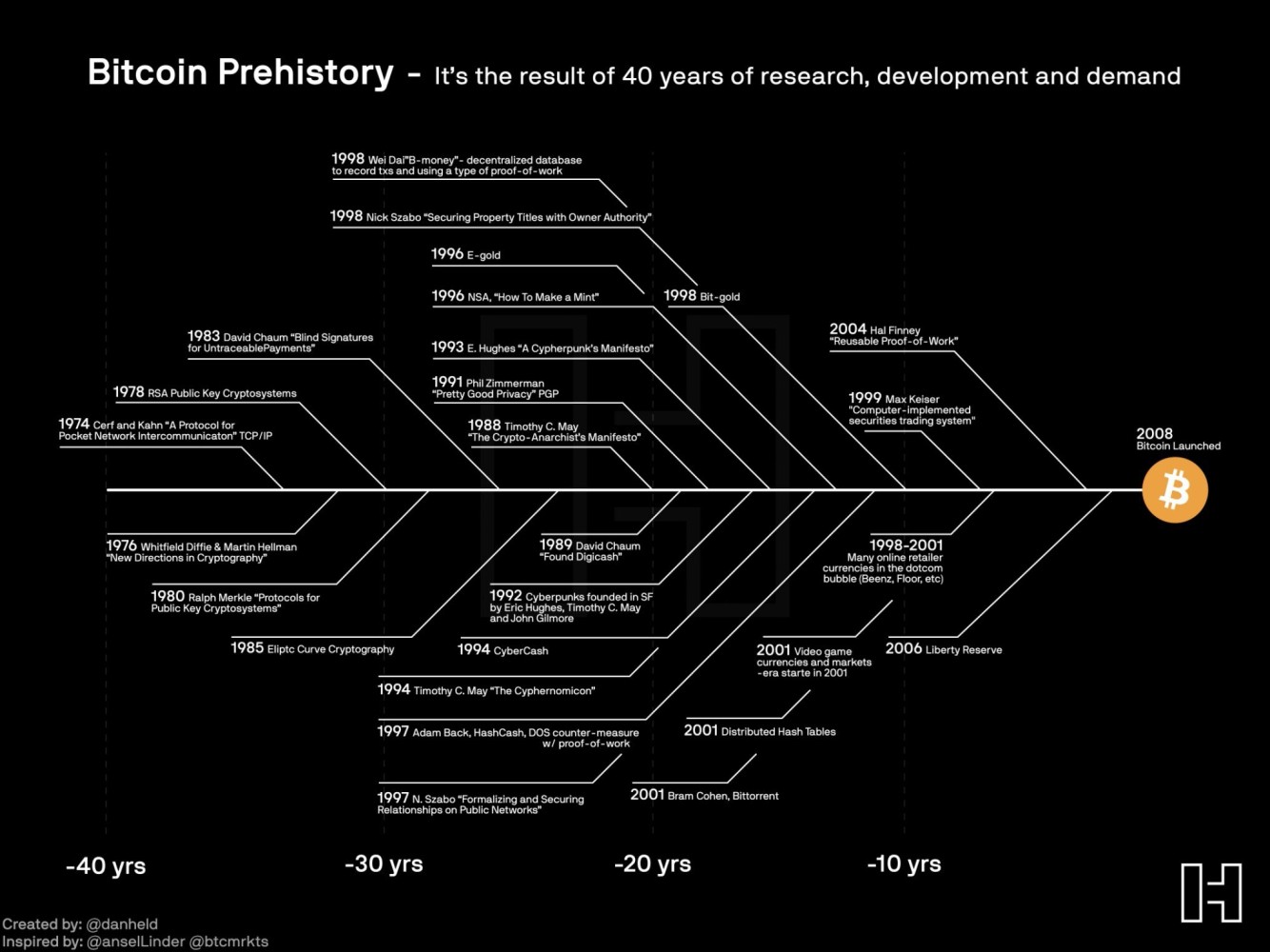
Bitcoin's Prehistory - Visual from Dan Held
Translated into high agency: "If there is no solution inside the frame, I'll change the frame."
Napoleon Hill, in How to Own Your Own Mind, wrote that there are two types of imagination:
- Synthetic imagination - rearranging old ideas into new forms.
- Creative imagination - reaching beyond existing ideas to create something truly original.
Most innovation happens through synthetic imagination - it's incremental, it builds on what's already there.
But Bitcoin was born from both.
Satoshi combined existing tools, but connected them in a way that had never been done before, and in doing so, solved a problem that most believed unsolvable. Proof-of-Work, peer-to-peer networking, digital signatures, timestamping - they all existed.
But through creative imagination, Satoshi turned them into a living organism:
A self-sustaining monetary network that operates without trust or permission.
That's the difference between invention and reconfiguration. One rearranges. The other creates new reality.
Satoshi didn't lobby. Didn't ask for permission. Didn't write a manifesto and stop.
Satoshi shipped code. Ran it. And invited others to verify it, attack it, break it.
And then disappeared - leaving no brand, no token pre-mine, no CEO seat.
The system built was so resilient that:
- No one controls issuance.
- No one can freeze your balance if you hold your keys.
- No one can stop the network without stopping the internet and global energy.
That's not a "startup." It's high agency embedded in code.
"Blockchain Is the Innovation" - They Miss the Point
"Blockchain" - without Proof-of-Work, without open participation, without real decentralization, security and without the proper incentive system of the Nakamoto Consensus - is just a slow database with marketing.
Bitcoin is the innovation.
Nakamoto Consensus is the genius.
Satoshi is what it looks like when one person refuses to accept that some problems cannot be solved.
Every once in a while, someone reminds the world that problems are only unsolvable until one person decides to solve them.
Satoshi did that.
→ Turned energy into trust.
→ Turned code into money.
→ Turned imagination into a network that serves everyone.
That's what happens when high agency meets purpose.